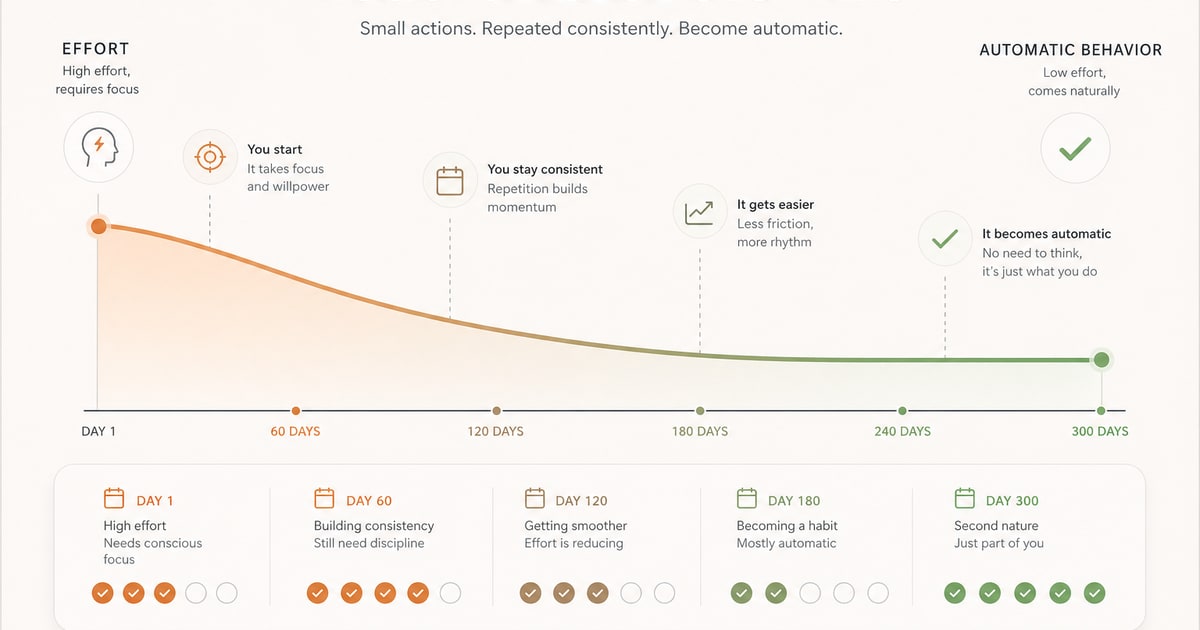
The “21-day habit” idea has stuck around far longer than it should. It loosely traces back to a 1960 observation by plastic surgeon Maxwell Maltz, who noticed that patients seemed to adjust to physical changes in about three weeks. Over time, that observation was paraphrased and repeated until it became a self-help rule with no real experimental support.
A 2025 systematic review from the University of South Australia offers a clearer picture. It found that the median time for a behavior to become automatic falls between 59 and 66 days, with some habits taking up to 335 days depending on complexity and context. Three weeks is not even close.
This matters more than it might seem. If you expect a habit to feel automatic by day 21 and it still feels effortful by day 40, it is easy to assume something is wrong with you. That is often the point where people quit. In reality, the issue is not personal failure, it is an unrealistic timeline. A longer, research-backed view of habit formation is not just more accurate, it is more forgiving.
What “Automatic” Actually Means
The review focused on automaticity, which is the point where a behavior requires less conscious effort and decision-making. This is a more precise goal than most habit trackers are built around.
A streak counter does not measure automaticity. It measures consecutive days, which is a rough proxy at best and a pressure mechanism at worst. You can maintain a perfect 30-day streak and still rely on willpower every day. On the other hand, missing a couple of days in month three does not erase progress and may still place you closer to true automatic behavior than you were earlier.
The research also highlights variation between habit types. Simple behaviors tied to existing cues, like drinking water after waking up or taking a short walk after lunch, tend to form faster. More complex habits that require sustained effort or focus take longer, sometimes much longer. There is no universal timeline, only your timeline.
The Long Game Needs Different Tools
If habit formation realistically spans two to ten months, the tools you use should reflect that reality. A tracker that treats a missed day as a broken chain works against how habits actually form. It prioritizes short streaks over long-term consistency and subtly shifts the goal toward maintaining a number instead of building a durable behavior.
Meridius approaches streaks as personal records rather than obligations. Your longest run is something you can revisit and surpass, not something that disappears after a missed day. This aligns more closely with the research.
Over a six-month period, you are going to miss days. That is not failure, it is part of the process. The key question is whether your tracking system treats those gaps as resets or as data points within a longer trajectory. When habits can take 200 days or more to become automatic, that difference in framing adds up.