Habit Stacking Is Misunderstood. Context Matters More Than Sequence.
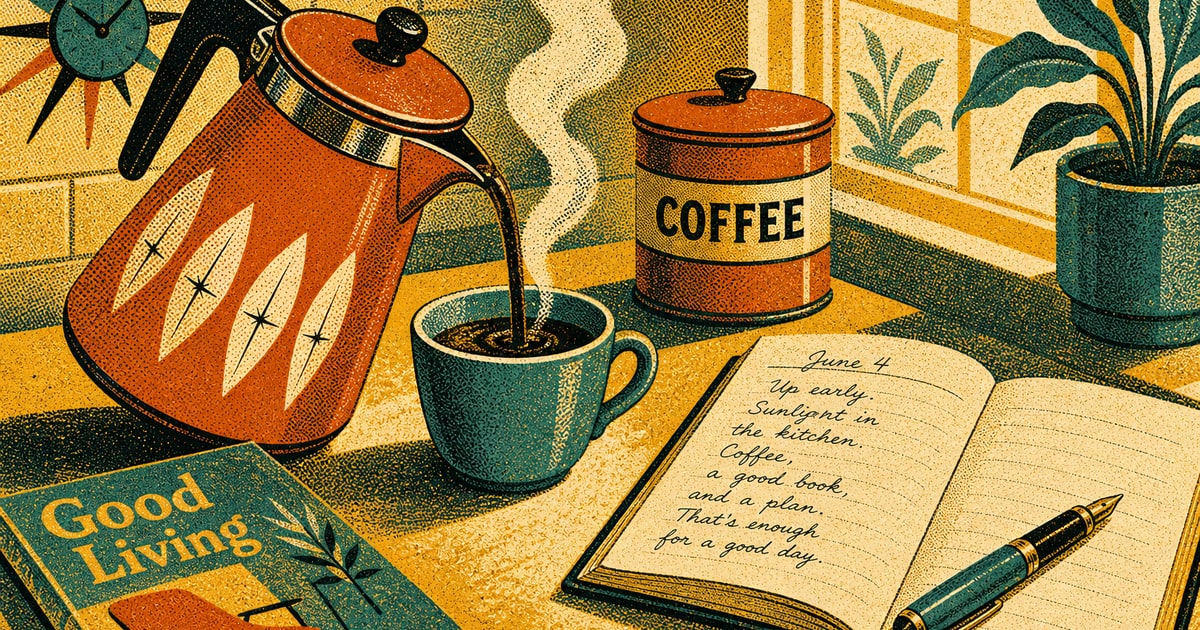
The standard advice on habit stacking is simple: after you pour your morning coffee, journal. After you brush your teeth, stretch. The formula is clean, memorable, and widely repeated.
But it emphasizes the wrong mechanism.
The coffee and the journaling are not linked because one follows the other. They are linked because they occur in the same context: the same environment, time window, and internal state. Remove that context and the sequence often collapses.
Behavioral science has been pointing to this distinction for years. Research by Wendy Wood and colleagues shows that a large portion of daily behavior is context-dependent, with nearly 43% of actions performed repeatedly in the same location and situation (Wood et al., 2002). Over time, the context itself becomes the cue. This means habits are less about chaining actions together and more about associating behaviors with stable environments.
When your kitchen in the morning is already tied to a calm, repeatable routine, any behavior introduced into that setting benefits from existing neural associations. You are not building a fragile chain. You are attaching a new behavior to a well-established cue.
Why Order-Based Stacking Breaks Down
Order-based stacking fails because it depends on continuity. Real life rarely provides that.
You travel. You wake up late. You skip coffee. A single disruption breaks the chain, and the rest of the stack often disappears with it. The system has no redundancy because its structure depends entirely on sequence.
Context-based habits are more resilient. If your anchor is “the first 20 minutes after I wake up” rather than “after coffee, then journaling, then stretching,” each behavior can still occur even if the order shifts. The shared context holds the system together.
This aligns with what psychologists call cue-dependent behavior. Habits are triggered by stable cues such as location, time, or preceding mental states, not strictly by preceding actions (Duhigg, 2012; Wood & Rünger, 2016). When the cue persists, the behavior is more likely to persist.
Why Most Habit Systems Feel Misaligned
Many habit trackers organize behaviors into categories like Health, Productivity, or Mindfulness. These categories are logical, but they do not reflect how habits are actually executed.
The brain does not group behaviors taxonomically. It groups them situationally.
A breathing exercise and a supplement reminder may belong to different categories, but if both happen within the same ten-minute window after waking, they are functionally linked. Treating them as separate ignores the shared cue that drives both behaviors.
Research on implementation intentions supports this idea. Plans that specify when and where a behavior occurs are significantly more effective than those that focus only on the action itself (Gollwitzer, 1999). Context is not just helpful. It is predictive.
Building Habit Stacks That Actually Stick
A more durable approach is to design habits around environments first, then behaviors.
Start by mapping your day in terms of context:
- Where are you?
- What time is it?
- What is your mental or emotional state?
Then assign behaviors to those contexts. Habits that share location, timing, and internal state tend to cluster naturally. Their order can vary without breaking the system.
This creates redundancy. If one behavior drops off, the others remain anchored to the same cue.
Over time, the context itself becomes a trigger. Entering that environment primes a set of behaviors rather than a single next step.
A Practical Example
A “wind-down” context might include:
- Reading for 10 minutes
- Taking a magnesium supplement
- Writing a short gratitude note
These actions are unrelated in category, but tightly linked in context. Performed consistently in the same environment and time window, they reinforce each other through shared cues.
Tools that allow users to group habits by context rather than predefined categories align better with how behavior actually works. Instead of forcing habits into abstract buckets, they let users mirror real-world routines.
For example, apps like https://meridius.app allow custom grouping based on user-defined contexts. Over time, opening a group like “wind-down” becomes a cue in itself, reinforcing the behavior loop through repetition and environmental consistency.
Sources
- Wood, W., Quinn, J. M., & Kashy, D. A. (2002). Habits in everyday life: Thought, emotion, and action. Journal of Personality and Social Psychology.
- Wood, W., & Rünger, D. (2016). Psychology of habit. Annual Review of Psychology.
- Gollwitzer, P. M. (1999). Implementation intentions: Strong effects of simple plans. American Psychologist.
- Duhigg, C. (2012). The Power of Habit. Random House.