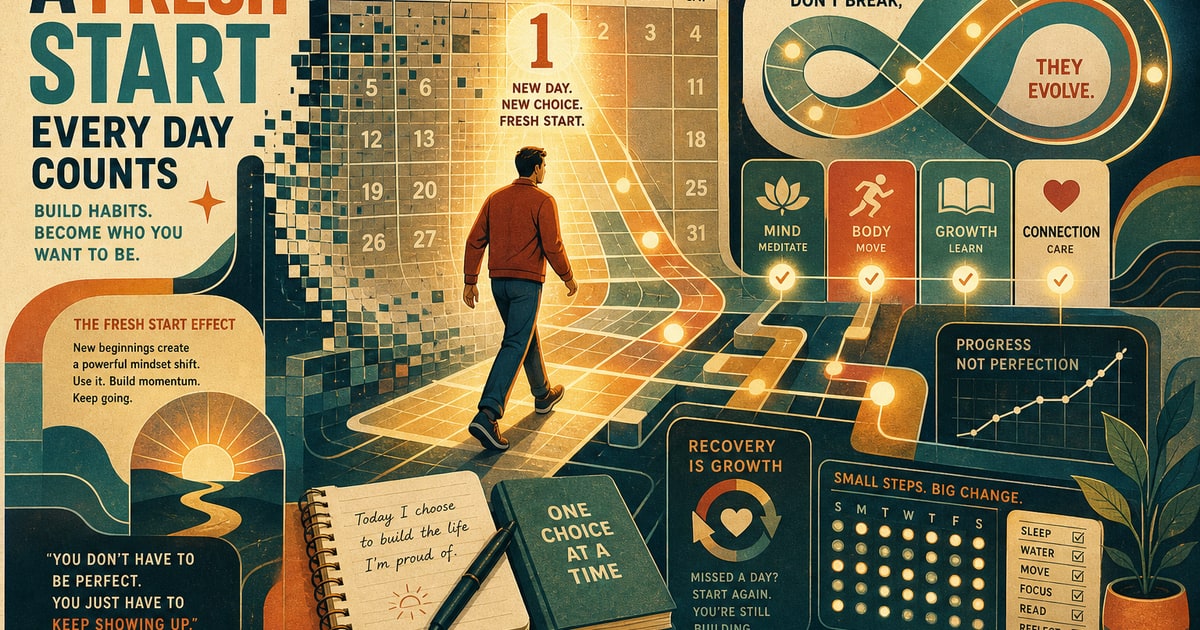
There’s a real psychological phenomenon behind the January surge in gym memberships, journaling apps, and habit tracker downloads. Researchers call it the fresh start effect: temporal landmarks like New Year’s Day, birthdays, or even Monday mornings create a mental separation between your past self and your future self. That separation feels empowering. It lowers the emotional weight of previous failures and briefly makes the future feel more open and controllable.
The motivation spike is real. The problem is what it depends on.
When motivation is tied too tightly to a calendar milestone, it inherits the fragility of that milestone. January 1st carries enormous symbolic weight, which makes it powerful for beginning — but equally painful for stumbling. Miss a workout in week two and the feeling collapses. You didn’t just skip a day; psychologically, it can feel like you broke the entire reset.
That’s the trap: the same mechanism that makes starting easier can make recovering much harder.
Why February Feels Different
By late January, the emotional distance from the landmark is gone. You’re no longer standing at the beginning of a new chapter; you’re somewhere in the middle of one. And the middle is where habits either solidify into identity or quietly disappear.
Research on the fresh start effect is fairly consistent: the motivational spike tends to last only a few weeks before regressing toward baseline. What matters after that isn’t inspiration — it’s infrastructure. The systems you built during the initial burst of motivation. The cues you established. The routines that became frictionless enough to survive ordinary life.
Without those systems, February becomes a quieter version of December.
A more useful way to think about change is that any day can function as a temporal landmark if you decide it does. A Thursday in March carries the same biological morning, the same opportunity for a first workout, a logged meal, or a five-minute walk, as January 1st.
What January offers is collective permission.
But permission doesn’t need to come from a date on a calendar. The motivation created by a milestone is often borrowed; the motivation created through repeated small choices is earned.
Every Day Is Already a Starting Point
This is where many habit trackers quietly fail people. They’re designed around the mythology of uninterrupted progress: streaks that reset to zero, dashboards that make missed days feel like erased progress, systems that imply momentum only counts if the chain remains unbroken.
In many ways, that design encodes the fresh-start trap directly into the product.
You get the excitement of January when you begin, and the emotional crash of February when you slip.
Meridius takes a different approach. Streaks still exist, but they’re treated more like personal records than ongoing obligations. A broken streak doesn’t erase progress or invalidate identity; it simply becomes a benchmark you can surpass later.
That subtle shift changes the relationship with time.
Instead of forcing users to preserve a perfect chain stretching back to some idealized starting point, the app simply reflects where they’ve been and leaves room for what today can become. Wednesday in the third week of February is just as legitimate a starting point as January 1st.
No special date required.
Progress still counts, even after interruption. The data remains yours. And every day retains the ability to become the day you begin again.